A fraudulent transaction can drain a bank account in minutes, and most victims only realize what happened after the money is already gone. Online banking fraud in Pakistan has grown alongside the country’s shift to mobile wallets, internet banking, and QR payments, and scammers have adapted just as fast as the technology. Understanding how these frauds work, what the law allows you to do, and how fast you need to act can be the difference between recovering your funds and losing them permanently. This guide covers common scams, the legal framework that protects victims, and the practical steps to take right after money leaves your account.
Understanding Online Banking Fraud in Pakistan
Online banking fraud in Pakistan refers to any unauthorized transaction carried out through internet banking, mobile apps, ATMs, or digital wallets using stolen credentials, OTPs, or manipulated victims. It includes phishing, SIM swaps, fake bank calls, and unauthorized fund transfers. The scale of the problem is significant. Federal Investigation Agency data recorded over 73,000 cybercrime complaints in 2024. Yet only 1,604 cases were formally registered, showing a wide gap between how many people are victimized and how many get formal legal action. Survey data from Visa suggests nearly half of Pakistani consumers encountered some form of online financial fraud in 2024, with a fifth facing repeated incidents.
Common Tactics Behind Digital Banking Scams
Fraud rarely happens through a technical hack alone. Most cases rely on tricking the victim into handing over access, which is why recognizing the pattern matters more than any antivirus software.
Phishing and Fake Bank Calls
Scammers pose as bank representatives, claiming your card is blocked or your account needs verification. They ask for your card number, CNIC, or login credentials over the phone, SMS, or a cloned bank website. Genuine banks never ask for your full PIN, CVV, or OTP over a call or message, and treating any such request as a red flag is the single most effective defense.
OTP and SIM Swap Fraud
Attackers who already hold partial account details use OTP theft or SIM swapping to intercept the one time code sent during a transaction. Banking malware has also become a growing factor, with Kaspersky documenting a 114 percent year on year rise in financial malware detections, much of it designed to capture OTPs directly from an infected device.
Fake Investment and Loan Apps
Fraudulent apps promise high returns or instant loans in exchange for upfront fees or account access. Once linked to a victim’s bank account or wallet, these apps initiate unauthorized transfers before the victim realizes the platform was never legitimate. The State Bank of Pakistan has flagged unlicensed digital lending platforms as a recurring source of consumer complaints.
The Legal Framework Governing Banking Fraud
Pakistan governs cyber enabled financial fraud primarily through the Prevention of Electronic Crimes Act 2016, amended in 2025, which criminalizes unauthorized access, electronic fraud, and identity theft under Sections 14 to 24. The 2025 amendment also restructured enforcement. The National Cyber Crime Investigation Agency, established in May 2024 and fully operational since April 2025, replaced the FIA’s Cyber Crime Wing and now holds exclusive jurisdiction over cybercrime investigations under an amended Section 30 of PECA. Separately, the State Bank of Pakistan’s Electronic Fund Transfers Regulations 2018 set out how banks must handle claims for unauthorized transactions, placing the burden on the bank to prove the customer properly authorized a transfer, rather than the other way around.
What To Do Immediately After a Fraudulent Transaction
Speed matters far more than most victims realize, since banks can often block or reverse a pending transfer only within a narrow window.
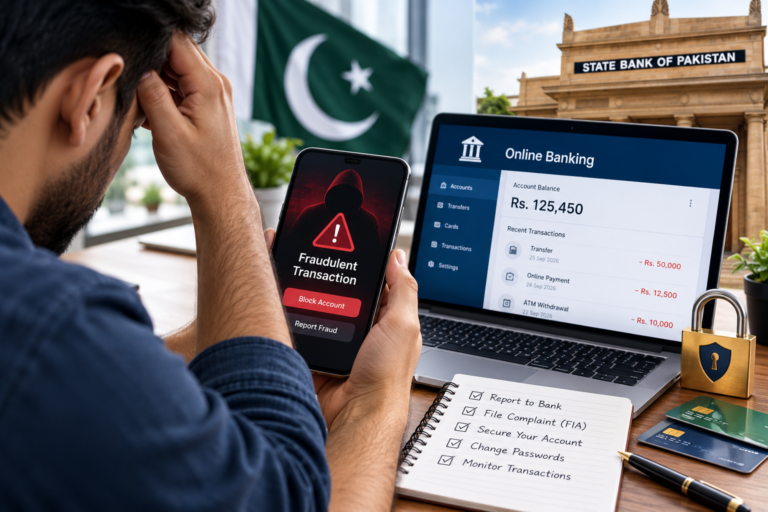
- Call your bank’s helpline immediately to freeze the account and block the card or app access.
- Change your online banking password and app PIN from a secure device.
- Save screenshots of the transaction, SMS alerts, and any messages from the scammer.
- File a written complaint with your bank requesting a formal dispute under the EFT Regulations.
- Report the incident to the National Cyber Crime Investigation Agency through its helpline or complaint portal.
How to Recover Your Money
Under the SBP’s Electronic Fund Transfers Regulations 2018, banks must investigate disputed transactions and refund the customer if they cannot prove the transfer was authorized, typically within a defined timeframe after the complaint is lodged. If your bank rejects the claim or delays beyond a reasonable period, you can escalate the matter to the Banking Mohtasib Pakistan free of charge, which has authority to direct banks to reverse unauthorized deductions. Filing a parallel complaint with the National Cyber Crime Investigation Agency strengthens the case, since a formal cybercrime report often supports the dispute you raise with the bank and the ombudsman.
Mistakes That Weaken a Fraud Case
Many victims lose recovery options because of delay or poor documentation, rather than the fraud itself. Waiting several days to report gives scammers time to move funds through multiple accounts, making recovery much harder for investigators to trace. Deleting SMS alerts or call logs removes evidence banks and the NCCIA rely on to verify the timeline. Accepting a bank’s initial rejection without escalating to the Banking Mohtasib also closes off a legitimate recovery route that many customers don’t know exists.
Moving Forward After a Banking Fraud Incident
Online banking fraud in Pakistan is not just a technical risk. It is a legal and financial process with specific timelines, required documentation, and agencies that each play a distinct role, from your bank to the NCCIA to the Banking Mohtasib. Victims who act within the first hours and keep clear records generally have a stronger path to recovery than those who wait. If you have lost money to a fraudulent transaction and your bank is not resolving the dispute, Chaudhary & Associates can review your case, help you prepare a formal complaint under PECA and the SBP regulations, and guide the escalation process where it is warranted.
FAQs About Online Banking Fraud in Pakistan
Is online banking fraud a criminal offense in Pakistan?
Yes. Unauthorized electronic transactions, phishing, and identity theft fall under Sections 14 to 24 of PECA 2016 as amended in 2025, and can result in imprisonment and fines depending on the offense.
Which agency handles banking fraud complaints now?
The National Cyber Crime Investigation Agency, which replaced the FIA’s Cyber Crime Wing in 2024 and holds exclusive investigative jurisdiction over cybercrime cases under PECA.
Can I get my money back after a fraudulent transfer?
Recovery is possible if you act quickly and the bank cannot prove you authorized the transaction, as required under the SBP’s Electronic Fund Transfers Regulations 2018. Outcomes depend on how fast funds were moved and how complete your documentation is.
What if my bank refuses to refund me?
You can escalate the complaint to the Banking Mohtasib Pakistan at no cost, and the ombudsman can direct the bank to reverse the deduction if the investigation supports your claim.
Do I need a lawyer to file a cybercrime complaint?
It is not legally required, but a lawyer familiar with PECA and SBP consumer protection rules can help draft the complaint correctly, meet documentation standards, and pursue escalation if your bank or the NCCIA delays action.