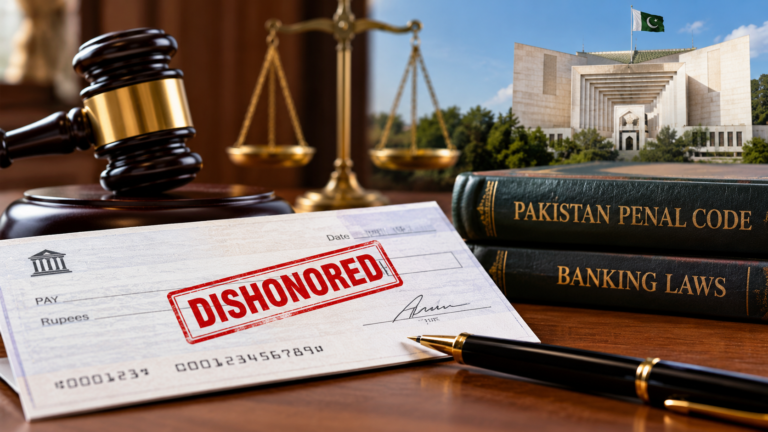
A buyer, borrower or business customer gives you a cheque against money already owed. You deposit it on time, but the bank returns it unpaid. The cheque issuer then stops answering calls or claims that the cheque was only given as security. If you have a cheque dishonored in Pakistan, you may have civil, criminal, or negotiated recovery options. However, a returned cheque does not automatically prove a criminal offence. You must examine the cheque, bank return memo, and original financial obligation together. Before filing an FIR or recovery case, preserve the banking record, calculate the exact amount and let a lawyer determine which remedy fits the evidence.
By Barrister Faisal Yaqoob
Who Should Use This Cheque Recovery Guide
This guide is for individuals and businesses who received a cheque against:
- A personal or business loan
- Goods supplied on credit
- Unpaid invoices
- Property payment
- Partnership settlement
- Services already provided
- An acknowledged financial liability
- A written settlement agreement
It is also useful for a person accused under Section 489-F of the Pakistan Penal Code. A cheque issuer may need a defense where the cheque was misused, altered, presented contrary to an agreement or issued without an existing repayment obligation.
Cheque Dishonored in Pakistan Requires Immediate Evidence
Do not depend only on a photograph of the cheque or a WhatsApp message stating that it bounced. Obtain the original cheque and the bank’s written return memo. The return memo normally records why the cheque was not paid. Possible reasons include insufficient funds, a closed account, payment stopped by the issuer, an irregular signature or another banking issue. The bank’s reason is important, but it does not decide the entire legal case. You must also prove why the cheque was issued and what amount was legally due. Preserve:
- Original cheque
- Bank return memo
- Deposit slip
- Relevant bank statement
- Agreement or acknowledgment
- Invoice and delivery record
- Loan payment evidence
- WhatsApp messages and emails
- Details of available witnesses
- Any earlier payment or settlement
Keep the original cheque secure. Give copies to other people unless the relevant authority or court specifically requires the original.
When Section 489-F PPC May Apply
Section 489-F of the Pakistan Penal Code concerns dishonestly issuing a cheque to repay a loan or fulfill an obligation when the cheque is dishonored upon presentation. A criminal complaint normally requires evidence relating to four important elements:
- The accused issued the cheque
- The cheque related to a loan or existing obligation
- The cheque was dishonored when presented
- Dishonest intention can be established from the facts
The word “dishonestly” matters. A banking error, genuine account dispute or failure to prove the underlying obligation may materially affect the case. Section 489-F provides criminal consequences, but it is not intended to replace every civil money dispute. A lawyer should review the complete transaction before advising an FIR.
Why Every Bounced Cheque Is Not Automatically A Crime
A cheque can be returned unpaid without satisfying every ingredient of Section 489-F. For example, the dispute may concern:
- A cheque allegedly issued only as security
- A cheque presented before the agreed date
- An amount not yet legally due
- A conditional business arrangement
- A disputed or canceled contract
- A cheque filled beyond the authority given
- A lost or allegedly stolen cheque
- A signature or account issue
- A payment already made through another method
The cheque holder should prove the original liability rather than rely only on dishonor. The issuer should not assume that calling it a “security cheque” ends the case. The court may examine the cheque’s purpose and whether an enforceable obligation existed when it was presented.
Should You Send A Legal Notice Before Filing A Case
A legal notice is not automatically required for every criminal complaint under Section 489-F. However, it can be strategically useful. A properly drafted notice can:
- Identify the cheque and bank return memo
- Explain the original transaction
- State the exact outstanding amount
- Demand payment within a reasonable time
- Record the issuer’s response or refusal
- Create an opportunity for documented settlement
- Preserve the cheque holder’s legal position
Do not send an exaggerated notice claiming an amount that the documents cannot support. Avoid threatening arrest as a method of private recovery. The notice should state the facts and available remedies professionally.
FIR Or Civil Recovery Suit Which Remedy Fits Your Case
Criminal and civil proceedings serve different purposes. A criminal complaint addresses alleged dishonest conduct. A civil recovery case seeks a decree for the amount legally payable.
When a Criminal Complaint May Be Considered
A complaint under Section 489-F may be considered where the evidence supports dishonest issuance of the cheque in discharge of a loan or obligation. Attach the original transaction, admissions, and bank records. If police refuse to act despite information disclosing a cognizable offense, further remedies may be assessed under the Code of Criminal Procedure. This should not be used to convert a weak contractual claim into a criminal case.
When Civil Recovery May Be Necessary
A civil recovery claim may be appropriate when the main objective is to obtain a court decree for money owed. The available procedure depends on the cheque, supporting documents, and the nature of the transaction. Do not delay the civil assessment while pursuing only a criminal complaint. Limitation periods apply to recovery claims. Check the relevant starting date and procedure against the complete record.
Can Both Remedies Be Used
Civil and criminal proceedings may sometimes run concurrently because they address different legal questions. This is not automatic permission to file every possible case. Each proceeding must have its own lawful basis. Choose a combined strategy only after assessing the evidence, cost, jurisdiction, and recovery prospects.
How To Prove The Original Loan Or Obligation
The cheque is important, but supporting evidence strengthens the claim. Depending on the transaction, useful proof may include:
- Written loan agreement
- Bank transfer to the cheque issuer
- Signed receipt
- Purchase order
- Tax invoice
- Delivery challan
- Property agreement
- Account statement
- Settlement document
- Messages admitting the debt
- Partial payment history
Cash transactions without receipts are harder to prove. Prepare a clear timeline showing when the obligation arose, when you issued the cheque, and when it was dishonored.
What If The Issuer Offers A Settlement
A genuine settlement can save time and cost, but you should document it carefully. Do not return the original cheque immediately after receiving only a promise of future payment. A settlement should identify:
- Total admitted amount
- Payment dates
- Instalment amounts
- Payment method
- Treatment of the dishonored cheque
- Consequences of default
- Status of pending legal proceedings
- Signatures and identity details
- Witnesses, where appropriate
If you receive a partial payment, issue an accurate receipt. Do not sign a “full and final settlement” unless the agreed amount has been paid or the document correctly reflects the remaining liability.
If You Issued The Cheque And Face An FIR
Do not ignore police calls, court notices or bail requirements. Preserve the agreement, payment record, and messages explaining why you issued the cheque. Your lawyer should immediately assess:
- Whether an FIR has actually been registered
- The exact allegation under Section 489-F
- Whether a loan or obligation existed
- Whether any payment was already made
- Whether the cheque was altered or misused
- Whether the complainant breached an agreement
- Whether arrest protection or bail is required
- Whether a civil dispute is being presented as a criminal offense
Pre-arrest bail is not automatic. It depends on the facts, available evidence and the court’s assessment. Early preparation is safer than waiting for an arrest attempt.
How Chaudhary & Associates Can Handle A Cheque Case
A cheque case requires more than sending a standard notice. Chaudhary & Associates can assist cheque holders and accused persons with:
- Reviewing the cheque and return memo
- Verifying the underlying financial obligation
- Calculating the recoverable amount
- Drafting and serving a legal notice
- Preparing a criminal complaint where justified
- Assisting with FIR and police proceedings
- Filing or defending money recovery proceedings
- Assessing pre-arrest or post-arrest bail
- Negotiating and documenting a settlement
- Representing clients before the appropriate court
For a case assessment, send the cheque copy, bank return memo, agreement, payment evidence and relevant messages. You may review our criminal lawyer services in Lahore or arrange an online legal consultation in Pakistan.
Documents To Send Before Booking A Consultation
Prepare one complete file containing:
- Front and back of the cheque
- Bank return memo
- CNIC details of the parties, if available
- Agreement or written acknowledgment
- Bank transfer or payment proof
- Invoice and delivery documents
- Complete message history
- Legal notice already sent or received
- FIR or police application, if any
- A one-page transaction timeline
Do not write on the original cheque or hand it to an unverified agent. Keep a scanned copy before submitting the original to any authority.
Protect Your Recovery or Defense Before Time is Lost
When a cheque is dishonored in Pakistan, the best next step depends on the original obligation, the bank memo, and the conduct of both parties. A legal notice may create a documented opportunity for payment. A civil case may be needed for recovery, while Section 489-F proceedings require evidence of the relevant criminal elements. Barrister Faisal Yaqoob and Chaudhary & Associates can review the full transaction, select the appropriate remedy, and handle notice, FIR, bail, recovery, or settlement proceedings. Contact the firm promptly if the issuer has disappeared, transferred assets or stopped responding, or if you face an FIR based on a disputed cheque. Outcomes depend on evidence and cannot be guaranteed.
FAQs About Dishonored Cheques in Pakistan
Is a bank return memo necessary for a cheque case?
It is an important document because it records the bank’s reason for returning the cheque. Preserve the original cheque, deposit record and return memo together.
Can an FIR be filed for every bounced cheque?
No. Section 489-F requires more than dishonor. The cheque must relate to a loan or obligation, and the facts must support dishonest issuance.
Does a security cheque fall under Section 489-F?
The label alone does not decide the case. The court may examine the agreement, purpose of the cheque and whether an enforceable obligation existed when it was presented.
Can I recover money through both criminal and civil proceedings?
Both routes may be available in some cases because they serve different purposes. Each proceeding must have an independent legal basis.
What should I send Chaudhary & Associates first?
Send the cheque, bank return memo, agreement, proof of payment, relevant messages, and any legal notice or FIR. These documents allow the firm to assess recovery, complaint, bail or settlement options.