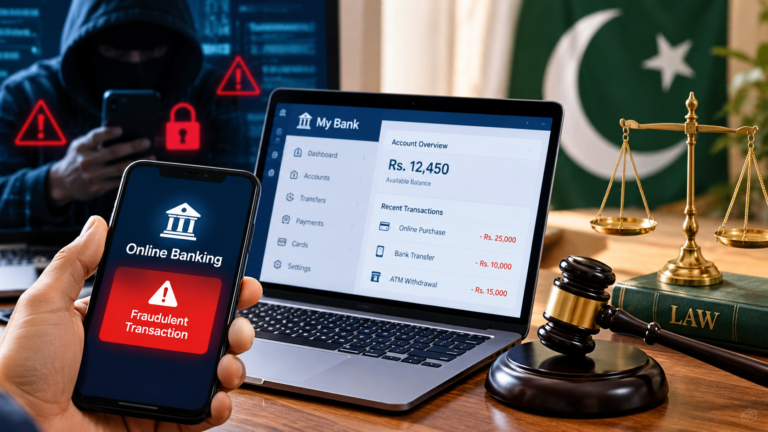
A sudden debit alert can turn an ordinary day into a financial emergency. Money may disappear after a fake bank call, a phishing link, a stolen OTP, a compromised mobile wallet, or unauthorized app access. If you face online banking fraud in Pakistan, speed matters, but panic can cause further loss. You need to block access, create a written record, preserve digital evidence, and approach the correct institutions.
This guide explains what to do immediately, how the bank complaint process works, when to contact the Banking Mohtasib and NCCIA, and what evidence can strengthen your position. It also clarifies an important point: reporting fraud does not automatically guarantee reimbursement. Liability depends on the facts, security controls, customer conduct, and the bank’s response.
Who Should Use This Legal Guide
Use this guide if an unauthorized debit, fake bank call, phishing link, suspicious application, or identity misuse has placed your bank account or business funds at risk.
What To Do Immediately After Online Banking Fraud in Pakistan
Report the fraud to your bank as soon as you discover it. Ask the bank to block the affected card, mobile application, internet banking access, and other exposed channels. State Bank of Pakistan instructions require bank call centers to handle fraud reports and temporarily block digital channels to prevent further loss. You may still make a request even if you cannot call from your registered number, though enhanced verification may follow. Take these actions in order:
- Call the bank’s official helpline using the number printed on the card or listed on its website.
- Block the affected card, account access, mobile wallet, and digital banking credentials.
- Identify each disputed transaction by date, time, amount, and recipient.
- Obtain a complaint or reference number and record the call time.
- Send a written complaint by email, portal, or branch submission on the same day.
- Change exposed passwords from a secure device and contact your mobile network if the SIM may be compromised.
Do not rely only on a telephone conversation. A written complaint proves when you notified the bank and which transactions you challenged.
Preserve Evidence Before It Disappears
Save debit alerts, transaction histories, suspicious messages, email headers, caller numbers, profiles, links, bank statements, and complaint acknowledgments. Prepare a timeline showing whether you clicked a link, shared an OTP, lost control of your SIM, or installed an application. Do not edit screenshots, delete conversations, or reset a relevant device before preserving the information.
File a Formal Complaint With Your Bank
Your written complaint should identify each transaction and request investigation, preservation of access logs and call recordings, tracing of the beneficiary account, and a reasoned decision. Avoid accusing a particular person without evidence. SBP’s published consumer-protection guidance states that banks should acknowledge complaints within 48 hours. Matters requiring scrutiny may receive an interim response after ten working days. Fraud-related complaints should receive a final reply within 30 days.
The State Bank’s Sunwai portal can route complaints and provide tracking. Keep every response. A verbal assurance that the matter is under investigation should not replace formal follow-up.
When the Bank May Be Responsible for the Loss
Reimbursement is not automatic. An investigation may examine authentication, credential disclosure, unusual transaction patterns, security controls, and how quickly both sides acted. SBP measures state that banks failing to implement prescribed digital-security controls could be liable to compensate affected customers within three working days of reporting. This is not an automatic three-day refund rule.
The control failure and facts still require assessment. A reported Lahore High Court bail ruling in August 2026 treated confidential customer data as property in a criminal breach-of-trust context. The alleged case involved organized cyber fraud. It shows the seriousness of insider misuse, but does not guarantee recovery in every dispute.
Escalate an Unresolved Complaint
If the bank rejects the claim or fails to resolve it within the applicable period, consider the Banking Mohtasib Pakistan. This independent statutory forum can entertain complaints involving fraudulent or unauthorized withdrawals, debit entries, and fund transfers. Its current complaint page asks consumers to approach their bank in writing before escalating the matter. Attach copies of the bank complaint, disputed statement, CNIC, correspondence, and evidence.
Do not send originals. Check current filing requirements because procedural instructions can change. A Mohtasib complaint examines the banking grievance, while criminal authorities investigate alleged offenders. Both routes may be appropriate.
Report Cyber Fraud to NCCIA
The National Cyber Crime Investigation Agency is the authorized federal cybercrime investigation agency. Its guidance allows complaints through its online form, Pakistan Citizen Portal, email, or a Cybercrime Reporting Center. Requirements include written particulars, a CNIC copy, and copies of evidence. For Lahore residents, NCCIA lists its Lahore reporting center at 8-B, G Block, Gulberg II. Verify the address and contact details on the official NCCIA website before visiting. Describe the incident chronologically and identify the disputed accounts, phone numbers, profiles, links, and transaction references. Avoid paying anyone who claims they can privately recover the funds through unofficial access. That may create another fraud or complicate the evidence.
Mistakes That Can Weaken a Banking Fraud Claim
Common mistakes include waiting several days, deleting messages, sharing further OTPs with supposed investigators, or accepting only a verbal response from the bank. Some victims also post full transaction receipts or CNIC images publicly. This can expose more personal information. Do not threaten bank staff or aggressively contact a suspected beneficiary. Use documented channels. Do not make false statements about whether credentials were shared.
An inconsistency between your complaint, call recording, and device record can damage credibility. For substantial losses, insider misuse, or a rejected claim, seek individual advice early. Chaudhary & Associates provides online legal consultation in Pakistan concerning banking and cyber issues. A criminal lawyer in Lahore can assess your options for criminal action.
Protect Your Rights After Digital Banking Fraud
The strongest response to online banking fraud in Pakistan is fast, truthful, and documented. Block every exposed channel, dispute each transaction in writing, preserve the digital trail, and obtain a reference number. Escalate an unresolved banking grievance and report suspected cybercrime to NCCIA.
A fraud report does not guarantee reimbursement, but you should challenge an unsupported rejection. The legal position depends on authentication records, security safeguards, reporting time, and the bank’s conduct. Barrister Faisal Yaqoob and Chaudhary & Associates can review the documents and advise on the correct forum. This article provides general information, not advice on specific facts.
Frequently Asked Questions About Banking Fraud
Can the bank reverse an unauthorized transaction?
It may be possible, particularly when funds are traced or security failures are established. Recovery is not guaranteed. Notify the bank immediately and request investigation of every disputed transaction.
Should I complain to the bank or NCCIA first?
Contact the bank immediately to block access and dispute the transaction. If you suspect cybercrime, identity theft, phishing, or unauthorized access, you may file a complaint with NCCIA alongside the banking process.
What if I shared an OTP with the fraudster?
Report the incident honestly. Sharing an OTP may affect the bank’s assessment, but it does not make reporting pointless. The fraudster’s conduct, bank controls, transaction pattern, and response time may still require investigation.