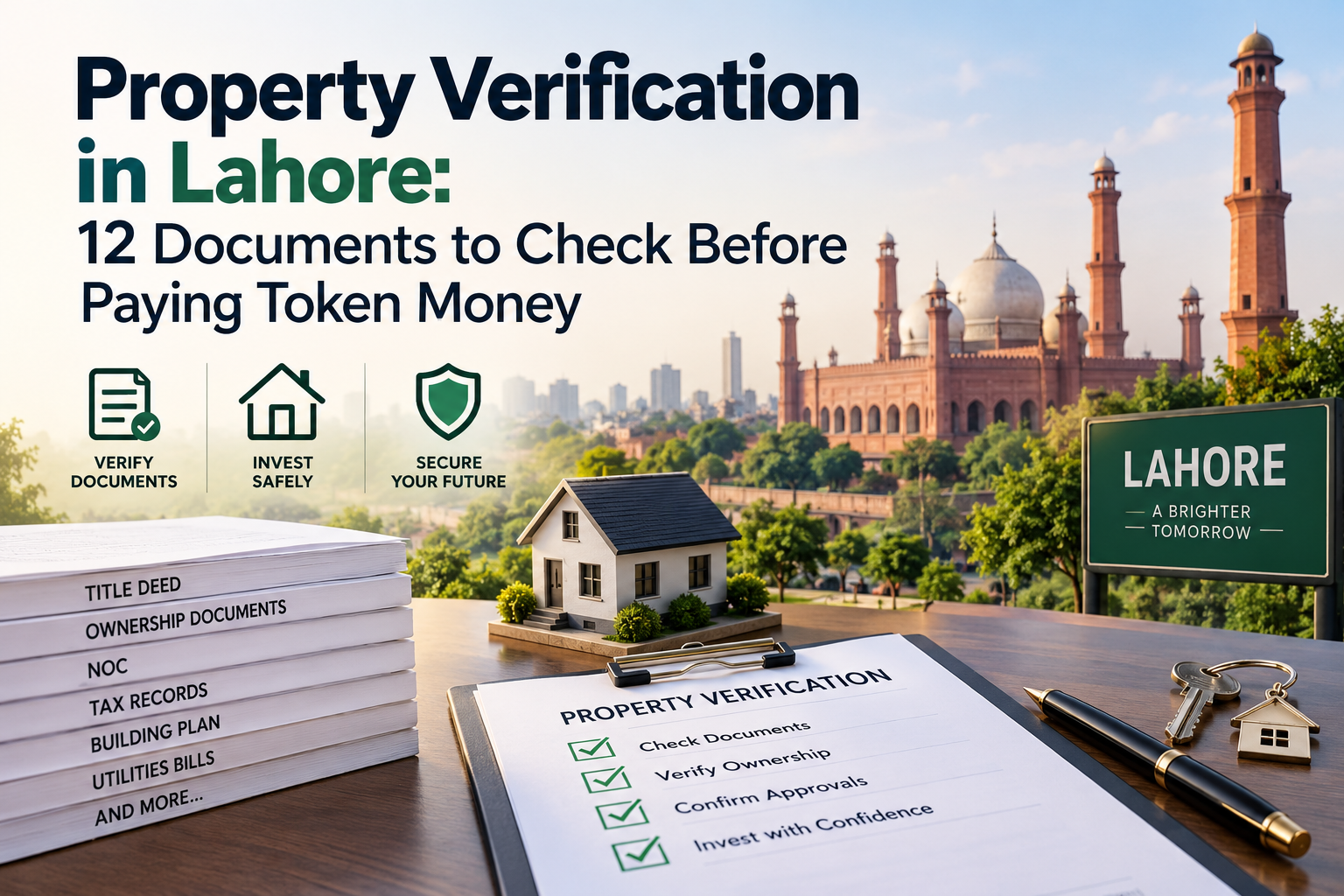
Buying a plot, house, apartment, shop or file in Lahore can be one of the biggest financial decisions you will make. Yet many buyers pay token money after seeing only a photocopy of a registry, a WhatsApp message from an agent, or a verbal assurance from the seller. That is not enough. A property may have incomplete ownership records, a pending dispute, an unauthorized scheme, an unverified Power of Attorney, unpaid dues or a seller who does not have legal authority to transfer it. Once token money has been paid, buyers often feel pressured to continue even when warning signs appear.
The safest time to verify a property is before you pay money, sign an agreement or hand over original documents. This guide explains 12 important documents and checks to consider before Property Verification in Lahore. Before paying token money, get the documents reviewed. Send clear copies of the available papers, property location and seller details to Chaudhary & Associates for a confidential property assessment.
Why Property Verification Matters
Property verification is not one document. It is a process of checking whether the documents, the seller, the official records, and the property itself all tell the same story. For example:
- A registry may exist, but the seller may not be the current owner.
- A person may hold a Power of Attorney, but it may be limited, expired, revoked or unsuitable for the proposed transaction.
- A plot may exist on paper, but the housing scheme may not have the approvals required for its status.
- A seller may own a share in property, but not the entire property being offered to you.
- A property may be occupied by someone else, subject to a dispute or have unpaid liabilities.
A legal review cannot remove every possible risk. It can, however, identify major red flags before your money and ownership position are exposed.
The 12 Documents and Checks to Complete
1. Seller’s CNIC and Identity Details
Start by confirming the identity of the person claiming to sell the property. Ask for a clear copy of the seller’s CNIC and compare the name, father’s name and address with the ownership documents. If the seller is acting on behalf of someone else, ask why and request the relevant authority documents. Be cautious if:
- The seller refuses to share identification before accepting a token payment.
- The name on the CNIC does not match the property documents.
- You are asked to deal only through an agent.
- The seller says original documents are “with someone else.”
- Several people claim to own the property but only one person is signing.
Identity matching is a basic step, but it can prevent serious confusion later.
2. Original Sale Deed, Registry or Title Document
The registry or sale deed is often considered the most important document in a property transaction. It should be reviewed carefully not merely photographed. Check whether it identifies:
- The seller and previous owner
- The property number, area and location
- The date of transfer
- The consideration or transaction details
- Registration details
- Any restriction, condition or special note
Ask to see the original document. A photocopy or scanned paper alone does not prove that the proposed transaction is safe. Punjab’s official Registry of Deeds public portal and Punjab Zameen resources provide official pathways for registry-related records and services.3. Complete Ownership Chain
Do not check only the last registry. Ask how the property reached the present seller. The ownership chain may include:
- Earlier sale deeds
- Allotment or transfer letters
- Gift deeds
- Inheritance or succession documents
- Court decrees
- Mutation/intiqal records
- Partition documents
- Power of Attorney records
A missing link in the chain can create a legal question about whether the seller has clear authority to transfer the property. This matters especially for inherited property, jointly owned property and older properties that have changed hands multiple times.
4. Fard / Land Record Extract
For land records covered by Punjab’s land-record system, a Fard can be an important document for checking recorded ownership details. A Fard should not be treated as the only proof of ownership. It should be considered together with the registry, transfer records, possession position and the facts of the transaction. Punjab Land Records Authority provides official online information about obtaining and verifying Fard records. If someone gives you a Fard, do not assume it is genuine merely because it looks official. Ask for the document ID and verification details, and have the property record checked appropriately.
5. Mutation / Intiqal Record
Mutation, commonly called intiqal, records a change in the revenue record. Depending on the property and transaction, it may be relevant after sale, inheritance, gift, partition or another change. Ask whether a mutation was completed after the seller acquired the property. If it was not completed, understand why before proceeding. A missing or disputed mutation can be a warning sign. It may also indicate that further verification or legal work is needed before a new transfer is attempted.
6. Allotment Letter, Transfer Letter or Possession Letter
For housing societies, authority, or developer properties, the key documents may not be a traditional land record Fard alone. You may need to review:
- Allotment letter
- Transfer letter
- Possession letter
- Membership certificate
- NOC
- Demand notices
- Payment schedule
- Society transfer record
- Any applicable building-plan approval
Make sure the plot, file, house or apartment number is the same in every document. A small mismatch in phase, block, plot number or area can become a major problem.
7. LDA Approval and Scheme Status
Before buying in Lahore, check whether the housing scheme is shown as approved, regularized, under process or illegal by the relevant authority. The Lahore Development Authority publishes separate information for approved schemes, illegal schemes and regular schemes. This does not mean every property in a listed scheme is automatically free from risk. It means scheme status is one essential part of due diligence. Never accept a dealer’s statement that a scheme is “approved” without independently checking the current official status.
8. Property Certificate, NOC and Relevant Approvals
Depending on the location and property type, a property certificate, NOC, building approval or authority clearance may be relevant. LDA provides services and status-checking tools for property approvals, verification, NOCs and development matters. Ask these questions before payment:
- Is an NOC required for this property?
- Is there an approved building plan, where applicable?
- Is the property subject to a notice, demolition issue or restriction?
- Is the transfer process currently open?
- Are there outstanding authority or society requirements?
A buyer should know what can actually be transferred not just what is being advertised.
9. Power of Attorney, if Someone Else Is Selling
If the person signing the sale agreement is not the owner, they may be relying on a Power of Attorney. This requires extra caution. Check:
- Who granted the authority?
- Is the owner alive and identifiable?
- Does the document clearly cover this specific property and transaction?
- Does it permit sale, transfer and receipt of money?
- Has it been properly attested or verified where required?
- Has it been revoked, superseded or challenged?
Do not send payment to an attorney holder without understanding their authority and the payment arrangement. A Power of Attorney is not automatically a substitute for careful title verification.
10. Tax, Utility and Society-Dues Record
Unpaid dues may create practical problems after you purchase a property. Ask for evidence of:
- Property tax payment
- Water, electricity and gas bills
- Housing-society dues
- Development charges
- Transfer fee
- Any installment or outstanding balance
- Maintenance charges for apartments or commercial units
Confirm which liabilities must be cleared before transfer and who is responsible for them under the sale agreement. Put the agreed responsibility in writing. Do not depend on a verbal promise that “all dues will be cleared later.”
11. Possession and Occupancy Check
A document may show one owner while someone else is physically occupying the property. Before paying token money, confirm:
- Is the property vacant, occupied by the owner, rented or under construction?
- Is there a tenant?
- Is anyone claiming possession or a share?
- Are there boundary, access or encroachment issues?
- Does the actual property match the location and dimensions in the documents?
Visit the property yourself where possible. If you live abroad, arrange reliable local verification supported by current photographs, video and document review. For a rented property, request the tenancy agreement and understand the tenant’s position before purchasing.
12. Sale Agreement and Token Receipt
Do not pay token money without a written receipt or agreement that protects your position. A properly drafted token or sale agreement should address:
- Full names and CNIC details of parties
- Exact property description
- Total sale price
- Token amount and payment method
- Deadline for verification and transfer
- What happens if title verification fails
- Who clears taxes, dues and transfer charges
- Possession date
- Consequences if either party defaults
- Required original documents
- Jurisdiction and dispute-resolution wording, where appropriate
The buyer should not sign a vague one-page receipt that only says “token received.” A carelessly prepared small document can lead to a large dispute.
Red Flags: Stop Before You Pay
Pause the transaction and seek advice if you see any of these warning signs:
- Seller refuses to show original documents.
- CNIC and ownership documents do not match.
- Agent asks for urgent cash payment.
- Property price is unusually low without a clear explanation.
- Seller says documents will be available “after token.”
- A Power of Attorney is broad, unclear or not independently verified.
- Property is occupied by someone not included in the deal.
- Plot number, dimensions, phase or block differ across documents.
- The scheme is not clearly approved or has an adverse official status.
- Multiple heirs or co-owners are involved but not all are signing.
- Seller insists on a handwritten receipt without full terms.
- You are asked to pay into an unrelated person’s account.
A rushed transaction often benefits the person hiding information not the buyer.
Property Verification Checklist Before Token Money
Before you pay, confirm that you have reviewed or requested:
- Seller CNIC
- Original registry/sale deed/title document
- Full ownership chain
- Fard or relevant land record
- Mutation/intiqal status
- Allotment, transfer and possession documents
- LDA or relevant scheme status
- Required approvals, NOCs or certificates
- Power of Attorney, if applicable
- Tax, utilities and society dues
- Physical possession and occupancy position
- Written token or sale agreement
Buy With Proof, Not Pressure
A property purchase should be based on verified documents, clear authority and a written agreement, not pressure from an agent or fear of missing a “good deal.” Chaudhary & Associates assists clients with property document review, ownership verification, sale agreements, Power of Attorney matters, property disputes, and civil litigation in Lahore and across Pakistan. Before paying token money, send us:
- Property location, phase, block and plot number
- Seller’s name
- Available property documents
- Your proposed payment and transfer timeline
- Any concerns you have already noticed
Frequently Asked Questions Property Verification in Lahore
Is Fard enough to buy property in Lahore?
No single document should be treated as enough in every case. A Fard can be important for relevant land records, but the buyer should also review title documents, ownership chain, transfer authority, possession and applicable approvals.
Should I pay token money before verification?
It is safer to verify documents before paying. If any token arrangement is unavoidable, the written agreement should clearly protect the buyer’s right to withdraw if legal verification reveals a material problem.
Can a property agent verify documents for me?
An agent may help with information, but the buyer should obtain independent verification. The person earning commission from a transaction should not be the only source of legal assurance.
What if the seller has a Power of Attorney?
The Power of Attorney should be reviewed carefully. Confirm whether it is valid, specific, properly executed and broad enough for the proposed transaction.
Can overseas Pakistanis verify Punjab property records online?
Punjab Land Records Authority provides online services and information for land-record matters, including Fard-related services and verification options. The exact process will depend on the record, property type and location.